Tricare ECHO and Autism Services in Florida: What It Covers (and What It Doesn't)

If you've searched the Tricare ECHO program for autism services, you've probably hit a confusing answer. Here's the short version: ABA therapy is covered under a different program called the ACD, not ECHO. This guide explains what each one actually does for Florida families.
What the Tricare ECHO program actually covers
The Tricare ECHO program, short for Extended Care Health Option, is a supplemental benefit for active duty family members with qualifying needs. It covers supports beyond standard Tricare, including:
- Respite care, up to 16 hours per month
- Durable medical equipment and supplies
- Special education and assistive technology training
- Institutional care when a residential setting is needed
ECHO provides up to $36,000 per fiscal year in government cost share for most services. Families pay a monthly cost share based on the sponsor's pay grade, roughly $29 to $250, and only in months they actually use benefits.
What ECHO does not cover is ABA therapy.
Where ABA therapy actually lives
ABA is covered under the Comprehensive Autism Care Demonstration, or ACD. It's a separate Tricare program built specifically to fund applied behavior analysis for people with autism.
Here's the difference that matters most: the ACD has no annual or lifetime cap on ABA hours, and those hours don't count against the $36,000 ECHO limit. Your child's BCBA sets the hours based on clinical need.
Do you need ECHO to get ABA?
Here's where it gets subtle, and where most families get tripped up. ABA is funded under the ACD, but active duty families must enroll in the Exceptional Family Member Program (EFMP) and register in ECHO to qualify for the ACD in the first place.
So both things are true at once. You sign up for ECHO as a gateway, but your child's ABA runs through the ACD. That single distinction causes more confusion than almost anything else in military autism care.
Why the confusion exists
Older guides and word of mouth still lump ABA under ECHO, because years ago the line between the programs was blurrier. Tricare has since organized it more clearly: ABA goes through the ACD, and ECHO covers other supports like respite.
If someone told you to "use ECHO for ABA," that advice is out of date. For the full picture, see our guide on how Tricare actually covers ABA.
How ECHO and the ACD work together
The good news is you don't have to choose. Many Florida families use the ACD for their child's ABA and ECHO for additional supports like respite care, which gives caregivers a real break.
Used side by side, they cover different needs: therapy through the ACD, family support through ECHO.
What this means for Florida families
Florida is in the Tricare East region, and Humana Military administers both the ACD and ECHO here. Keep one timing rule in mind: there's no retroactive ECHO registration, so register before you need services, not after.
If you're setting up care in the Tallahassee area, our guide to in home ABA in Tallahassee walks through what therapy looks like day to day.
We help you route it correctly
The Tricare ECHO program and the ACD are easy to mix up, and a wrong turn costs time. The Kudos Autism Therapy team helps Florida families send ABA through the right door and start without the guesswork.
Kudos helps Florida families route ABA through the right program, start to finish.
Talk to a BCBA: Free Consultation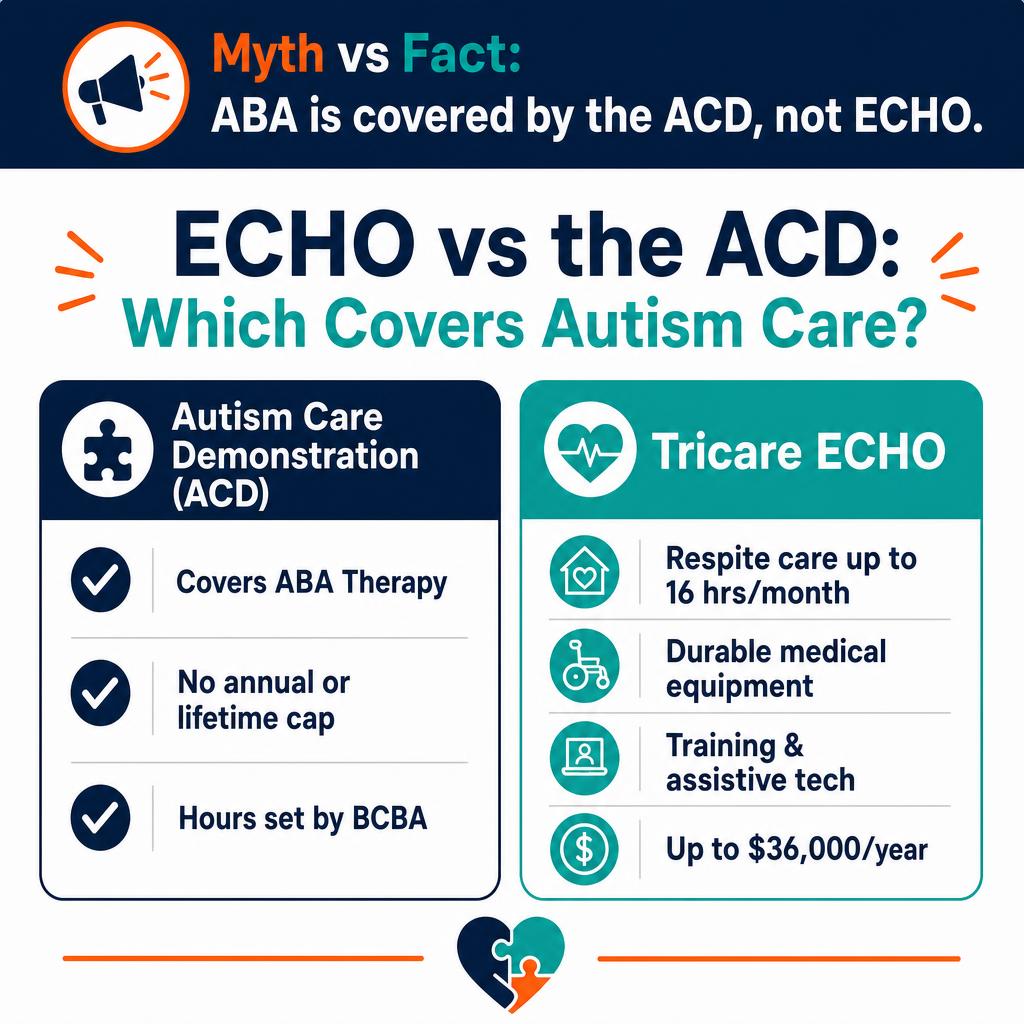
General information only, current as of 2026. This isn't individualized medical or insurance advice. Confirm your specific coverage and cost shares with Tricare, Humana Military, and your EFMP or ECHO coordinator.